

Most personal injury firms obsess over cost per lead when they should be tracking cost per signed personal injury case.
At On Point Legal Leads, we’ve seen practices cut their actual acquisition costs in half simply by shifting focus to what truly matters: converting leads into paying clients.
Your lead source’s price tag means nothing if your conversion rate is terrible. The real ROI question isn’t what you pay per lead-it’s what you pay for each case that actually signs.
Cost Per Signed Personal Injury Case: The Metric That Actually Matters
The Gap Between Lead Cost and Case Cost
Cost per lead and cost per signed personal injury case operate in entirely different universes.
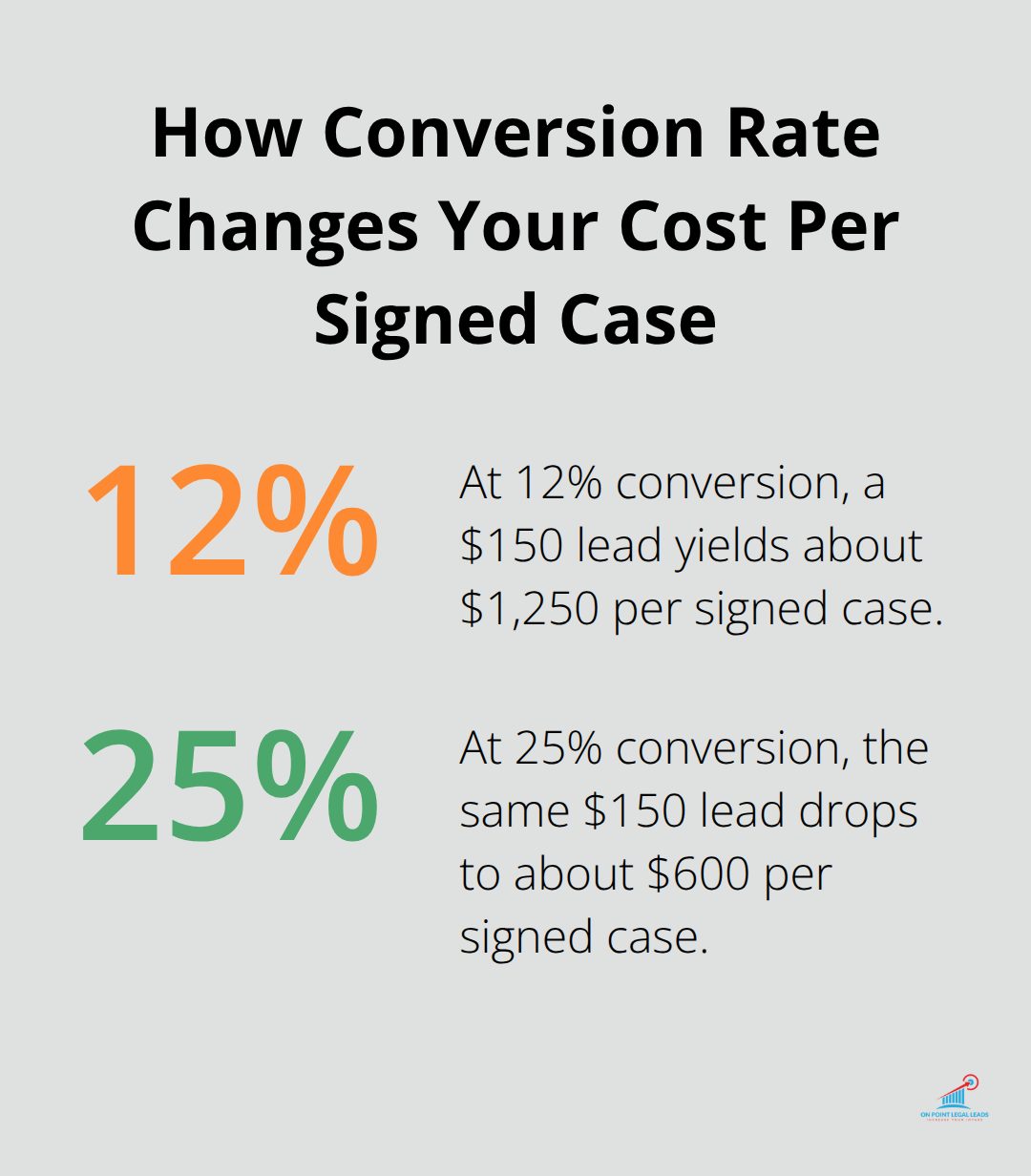
A $150 lead that converts at 12% costs you $1,250 per signed case. That same $150 lead converting at 25% drops your actual acquisition cost to $600. The difference between those two scenarios is the entire margin in your practice.
Most PI firms track the first number and ignore the second, which explains why they hemorrhage money on lead generation while believing they’re getting a deal.
The truth is brutal: a cheap lead with poor conversion destroys ROI faster than an expensive lead with strong conversion ever could. Your intake process, case screening criteria, follow-up speed, and case quality standards determine whether your lead investment pays off. If you don’t track conversion from lead to signed case, you’re flying blind.
Conversion Rate Beats Volume Every Time
Buying 100 leads at $150 each costs $15,000. If 8 convert, your cost per signed case sits at $1,875. Purchase 50 leads at $200 each with a 20% conversion rate and you’ve spent $10,000 to sign 10 cases at $1,000 per acquisition. The second scenario costs 47% less despite the higher per-lead price. This is why exclusive leads command premium pricing. Data shows exclusive leads convert at 10-15%, while shared leads typically convert at 5–10%.
The conversion uplift justifies the cost increase. Shared leads at $40 with a 10% conversion rate cost $400 per signed case. Exclusive leads at $200 with a 15% conversion rate cost $1,333 per signed case. That appears higher. But if your exclusive leads average $4,500 in fees versus $2,000 for shared leads, your revenue per signed case flips the economics entirely. Most firms make their critical mistake here: they optimize for cost per case without considering the quality and settlement value of those cases.

Cost Per Signed Personal Injury Case: The Real ROI Calculation
True ROI when considering acquisition of personal injury leads requires four numbers: total marketing spend, leads generated, conversion rate, and average case value.
Suppose you spend $10,000 monthly on leads and generate 75 leads with a 16% conversion rate. That’s 12 signed personal injury cases. If your average case value is $3,500, your monthly revenue from marketing is $42,000. Your ROI is 320%, which exceeds the 300%+ benchmark for personal injury.
Now imagine a competitor spending the same $10,000 on cheaper leads, generating 150 leads with a 6% conversion rate. That’s 9 signed cases at $3,500 each, producing $31,500 in revenue. Same spend, 25% less revenue, because volume masked poor conversion. As you can see, focusing on cost per signed personal injury case is where the law firms should focus their efforts.
Response time amplifies this gap significantly. Research indicates 25% of law firms respond to online leads in under 5 minutes, and contacting prospects within 5 minutes can boost conversions significantly. A firm contacting leads within 5 minutes might convert 20% of shared leads instead of the typical 10%. That doubles your case output without increasing spend. Your intake process matters equally.
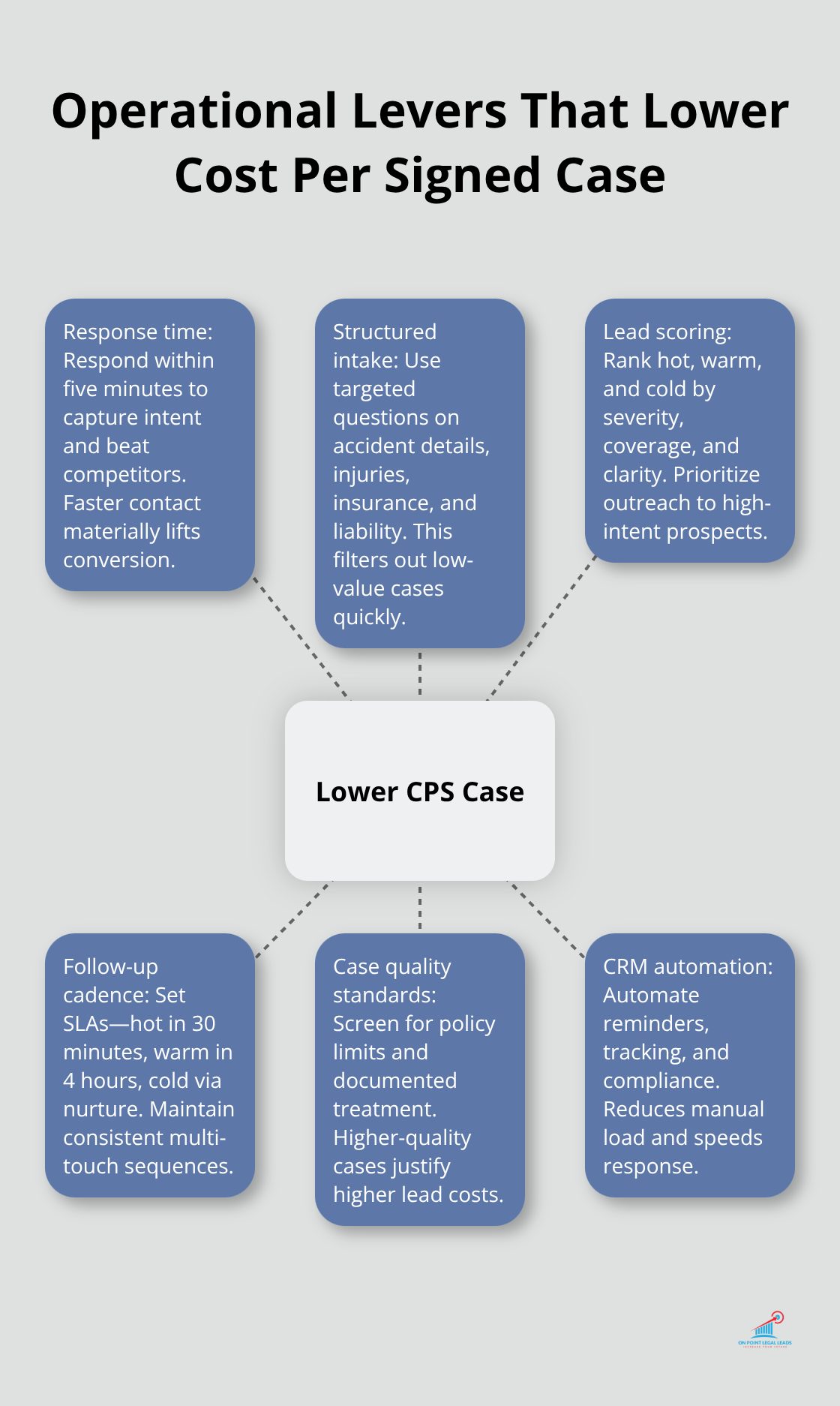
A structured intake asking targeted questions about accident details, injuries, insurance status, and liability indicators separates serious prospects from window shoppers. Lead scoring-ranking prospects hot to cold based on case viability-ensures your follow-up effort targets high-intent prospects first. These operational factors remain invisible in cost per lead but dominate cost per signed case and ultimately determine whether your lead investment generates sustainable practice growth.
What Your Practice Should Actually Cost Per Signed Personal Injury Case
The Real Benchmark for Personal Injury Firms
We’ve noticed that personal injury firms averaging $1,500 to $4,000 per signed case typically operate within acceptable ROI territory, though geography and case type create substantial variation.
A PI firm in Los Angeles pays $250 per exclusive motor vehicle accident lead with a 12% conversion rate and lands at $2,083 per signed case. That same firm buys shared leads at $80 with a 10% conversion rate and costs $800 per signed case on paper, but those cheaper leads often involve longer follow-up cycles, lower case quality, and settlement values 30-40% below exclusive prospects.
The real benchmark isn’t the lowest cost per case-it’s the cost per case that generates sustainable revenue after accounting for case quality, settlement amounts, and the operational overhead required to convert those leads.
Hidden Costs That Inflate Your True Cost Per Signed Personal Injury Case
Most PI firms underestimate their true cost per signed personal injury case because they exclude intake labor, follow-up time, and CRM infrastructure from their calculations.
A dedicated intake specialist earning $35,000 annually handles 200 leads monthly and adds roughly $15-20 per lead to your true acquisition cost before your first dollar of revenue arrives. These operational expenses sit outside your lead purchase budget but directly impact whether your lead investment actually produces profit.
Your CRM platform, automated follow-up systems, and compliance tools add another layer of cost that most firms ignore when calculating cost per signed case. When you factor in hidden intake labor and CRM infrastructure costs, a lead that appears to cost $150 actually costs $170-190 by the time your intake team qualifies it and enters it into your system.
Case Type Determines Your Cost Per Signed Personal Injury Case Ceiling
Practices handling primarily motor vehicle accident cases typically see lower cost per signed personal injury case than those pursuing complex catastrophic injury litigation, because MVA leads convert faster and require less qualification depth.
A firm specializing in rear-end collisions with $2,500 average case value can justify spending $300 per exclusive lead if conversion reaches 18-20%, landing at $1,500-1,667 per signed case. That same firm chasing catastrophic spinal cord injury cases with $15,000 average value might spend $400 per lead and still achieve superior ROI because the higher case value absorbs the acquisition cost more efficiently.
Even our clients have told us that the case type and average settlement value determine how much you can afford to spend per lead while maintaining healthy margins.
The Dangerous Gap Between Cost Per Case and Case Value
The critical gap most practices miss involves comparing their actual cost per signed case compared to average case value. A firm spending $2,000 per signed case but averaging $3,500 in fees appears healthy on the surface. That same firm spending $2,000 per signed case paired with average fees of $2,200 operates on razor-thin margins that disappear instantly when a case settles below expectations or a client dispute emerges. Calculate your own numbers: total marketing spend divided by signed cases equals your baseline. Then multiply that figure by your average case value to determine whether your lead source actually generates profit or merely creates the illusion of activity.
Identifying Your Operational Efficiency Level
Practices spending under $1,500 per signed case typically operate exclusive lead sources with strong intake discipline and fast response protocols. Those exceeding $3,500 per signed case either work with shared or lower-quality lead sources, maintain weak conversion processes, or both.
The gap between those extremes represents pure operational and sourcing efficiency. Your position within this range reveals whether your intake team qualifies prospects effectively, whether your follow-up speed matches market standards, and whether your lead source delivers prospects with genuine conversion potential.
Firms at the lower end of this spectrum have solved the equation: they’ve paired quality lead sources with disciplined intake processes and rapid response times. Understanding where your practice falls within this range and what drives your position there determines your next strategic move.
How to Cut Your Cost Per Signed Case Without Sacrificing Lead Quality
Structure Your Intake Process to Eliminate Weak Prospects
Your intake process determines whether cost per signed personal injury case improves or deteriorates.
Most PI firms treat intake as clerical work when it should be your most strategic operation. A structured intake asking the right questions separates $500-per-case prospects from $5,000-per-case opportunities. Start with accident details: date, location, vehicle types involved, and whether police documented the incident. Then move to injuries: severity, treatment received, ongoing medical care, and prognosis. Ask about insurance directly: does the prospect have health coverage, auto insurance with adequate limits, and is the at-fault party insured. Ask whether they’ve retained counsel elsewhere. These questions take five minutes and eliminate 40–50% of leads that shouldn’t consume your team’s time.
A prospect with minor soft tissue injuries, no ongoing treatment, and a $15,000 policy limit represents fundamentally different economics than someone with documented fractures, six months of physical therapy, and a $100,000 policy. Your intake form should capture this distinction immediately.
Implement lead scoring after intake: rank prospects hot, warm, or cold based on injury severity, liability clarity, insurance coverage, and settlement potential. Contact hot prospects within the first 30 minutes. Warm prospects receive contact within four hours. Cold prospects enter a nurture sequence.
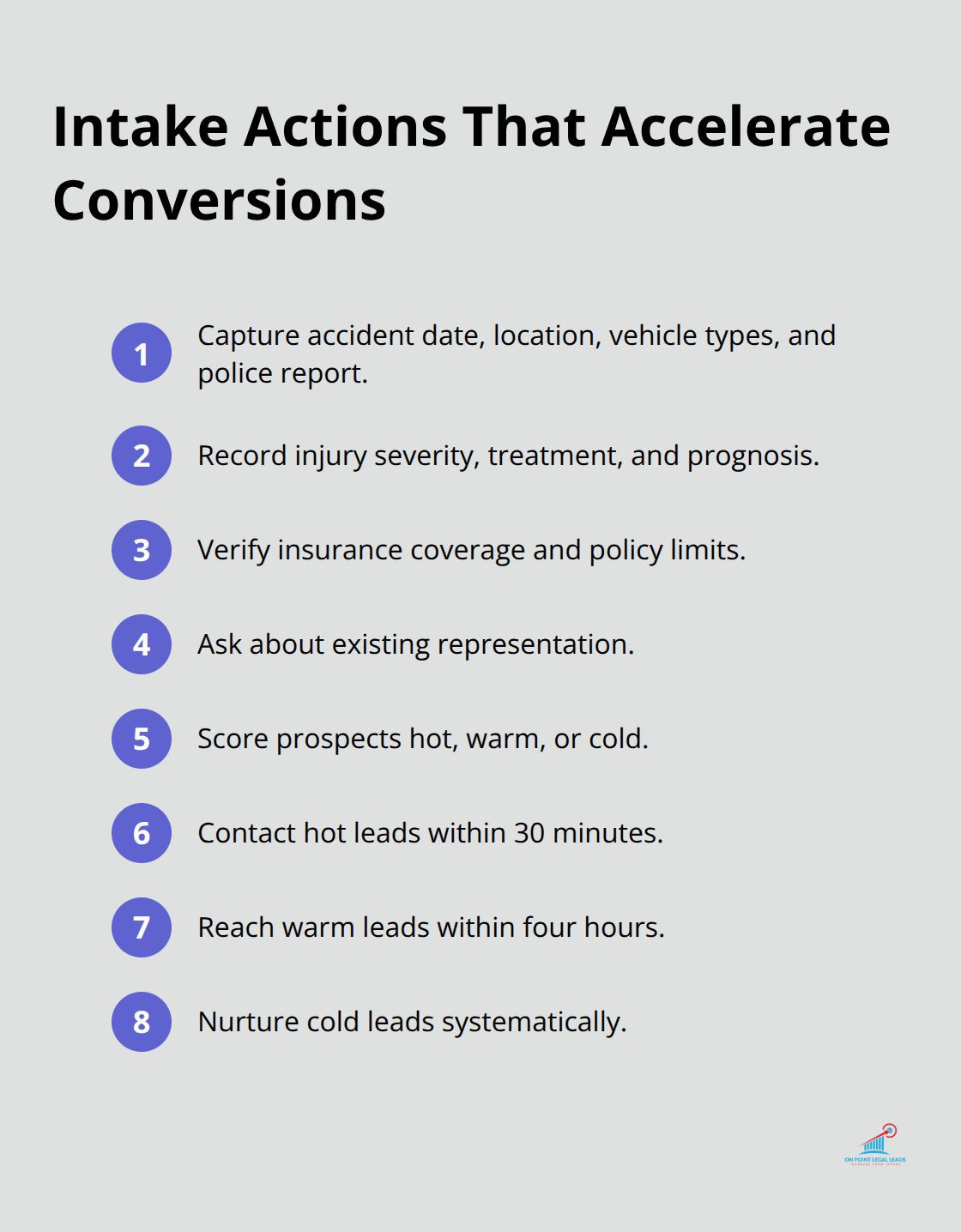
This tiering ensures your follow-up effort targets cases with genuine revenue potential first, which mathematically lowers your cost per signed case because you close higher-value prospects faster.
Track Conversion Performance by Source and Negotiate Accordingly
Your lead source’s actual conversion performance should drive every negotiation and sourcing decision. Track your cost-per-lead by source obsessively: shared leads versus exclusive, Google Ads versus Facebook, referrals versus purchased leads. Calculate the true cost per signed case for each channel monthly. If your exclusive motor vehicle accident leads from one vendor convert at 18% while another vendor’s exclusive leads convert at 12%, the first vendor justifies a 30–40% price premium because the math works.
Document case values alongside conversion rates: a lead source producing 15% conversion with $2,800 average case value outperforms a source with 20% conversion but $1,500 average case value. Most firms negotiate pricing based on per-lead cost alone, which is strategically backwards. Request vendor performance data on their leads: how many prospects they contact before one accepts representation, what percentage have ongoing medical treatment, what their average settlement value is for cases that close. Vendors with real data will provide it. Vendors who refuse or deflect are hiding poor conversion performance.
Align Pricing With Conversion Thresholds and Delivery Speed
Negotiate price reductions tied to conversion thresholds. Offer to pay premium rates for leads that convert above 18% and request price adjustments if conversion falls below 12% over a 90-day period. This aligns your incentives with the vendor’s performance rather than their ability to generate volume. Conversion drops 400% after just 5 minutes. If a vendor cannot deliver leads in real-time, their per-lead price should reflect that conversion penalty. Negotiate accordingly.
Exclusive leads cost more upfront but eliminate competition, which accelerates decision-making and improves conversion substantially. Shared leads force you into a competitive race: the first attorney who contacts the prospect gains the advantage. This means your response time becomes your competitive advantage. If you cannot respond within five minutes consistently, shared leads waste your money. Your operational capacity determines your sourcing strategy.
Match Your Lead Source to Your Response Capacity
A firm with a dedicated intake specialist answering phones within five minutes should purchase shared leads aggressively. A firm with delayed intake response should purchase exclusive leads despite the premium because shared leads will convert before your team reaches them. Calculate the true cost per signed case for each scenario before committing budget. Exclusive leads remove the response-time race entirely. Your team contacts prospects immediately without competing against other attorneys, which simplifies the conversion equation and lets your case quality and intake process drive results rather than speed alone.

Final Thoughts on Cost Per Signed Personal Injury Case
Pull your marketing spend from the last 90 days, count your signed cases, and divide one by the other to establish your baseline cost per signed case. Compare that number against your average case value-if your acquisition cost exceeds 40 percent of what each case generates, your lead source or conversion process needs immediate attention. Firms that win in personal injury lead generation stopped chasing cheap leads and started chasing profitable cases by pairing quality sources with disciplined intake and rapid response.
The firms scaling sustainably have solved the equation through three commitments: they track conversion by source religiously, calculate true cost per signed case monthly with operational overhead included, and align sourcing strategy with response capacity. A firm unable to respond within five minutes should not purchase shared leads regardless of lower per-lead pricing, while a firm with dedicated intake capacity should exploit shared leads aggressively because response speed becomes the competitive advantage. Your operational capacity determines your sourcing strategy, not the other way around.
We at On Point Legal Leads deliver exclusive motor vehicle accident leads with rigorous pre-qualification screening and real-time delivery built into every prospect. Your cost per signed case improves because our leads convert at higher rates, not because they cost less-and that distinction separates sustainable practices from those trapped in endless lead-generation cycles.

